
Collaborative Modeling & Simulation
Partnering with research and industry to model complex biological systems
Neovivum develops computational platforms for precision medicine, and the modeling expertise behind those platforms is available to partners directly. We collaborate with biotech and pharmaceutical companies, medical device developers, and research groups who need to simulate biological systems that are too complex, too costly, or too slow to explore through experiment alone.
These engagements are genuine collaborations. Our partners gain access to advanced simulation capabilities without building an in-house modeling team, and we refine methods that strengthen our own platforms. The result is work that advances both sides: concrete answers to a partner’s immediate question, and deeper computational tools for the problems that matter across precision medicine.
What We Model
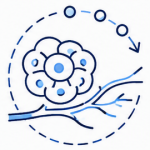
Tumor progression and tissue-scale dynamics
We build spatial models of how tumors grow, how cell populations shift over time, and how the surrounding microenvironment shapes disease behavior. These simulations let partners explore scenarios that would take months or years to observe experimentally, and test hypotheses about progression and treatment response before committing to costly studies.
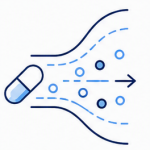
Drug distribution and transport
We simulate how therapeutic compounds move through tissue: diffusion across biological barriers, uptake and clearance, and the release kinetics of drug-delivery systems. This supports decisions about dosing, formulation, and delivery design, grounding them in quantitative prediction rather than trial and error.
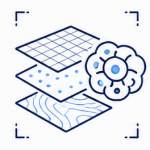
Image-based and sample-specific modeling
We construct models directly from experimental data, extracting geometry and parameters from histology, biopsy images, and other imaging sources. Rather than relying on idealized geometries, this produces simulations that reflect the real structure of a specific sample or patient, which is essential when structural detail drives the outcome.
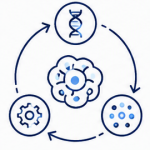
Coupled multiphysics systems
Many biological questions cannot be answered by one type of physics alone. We couple mechanical behavior, transport processes, and biological dynamics into unified models, capturing how, for example, tissue mechanics, cell growth, and drug diffusion influence one another within a single evolving system.
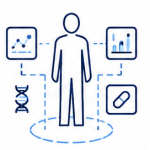
Digital twins and personalized prediction
Bringing these capabilities together, we develop digital twin frameworks that integrate multiple data sources into predictive, sample-specific models. This is the core of our platform work, and the same approach can be adapted to a partner’s specific biological system or therapeutic question.
How we work
Engagements are scoped to fit the partner’s needs and stage. A focused feasibility study can establish whether a modeling approach is viable before larger investment. A full simulation campaign can carry a question from setup through parametric exploration to validated prediction. And where a partner needs a capability that does not yet exist, we develop the methodology itself.
Feasibility study
Full simulation campaign
Methodology development
Engagement models
fee-for-service
delivering a defined piece of modeling work for an agreed price
collaborative grant partnership
joining a consortium as the modeling and simulation partner within a funded project
Our approach
We rely on industry-standard multiphysics platforms and established modeling frameworks.
We combine these with methods developed in-house through our research programs.
We are equally comfortable delivering a self-contained analysis and working as an embedded modeling partner over a longer collaboration.
In practice
In a recent engagement, we developed a multi-level simulation plan for a research partner developing a targeted drug-delivery implant. The work progressed from the mechanical compatibility of the implant with surrounding tissue, through the effect of material porosity on structural behavior, to a coupled model in which drug release, cell growth, and evolving tissue structure influence one another, built on geometry extracted directly from experimental imaging. Each stage produced concrete design guidance while feeding into a single predictive picture of how the device would behave in vivo.